Understanding Energy Management in Your RV
Most RV owners don’t struggle with their engine, their slide-outs, or their water system. Power does it. This guide explains what energy management actually does and what to look for in a well-designed system.
Why RV power trips people up
Your RV runs multiple systems simultaneously: air conditioning, refrigeration, water pump, lighting, charging ports, entertainment. Each draws power. The problem isn't that these systems exist. It's that they compete for a finite supply, and without something actively managing that competition, you end up guessing what you can run and when.
The most common power complaints from RV owners aren't equipment failures. They're visibility failures. Tripped breakers when running the microwave and AC at the same time. Dead batteries by morning after a night of dry camping. Uncertainty about which appliances are safe on battery power alone. Frustrating transitions when switching between shore power, generator, and battery. These problems are predictable and solvable. The issue is usually that no one is managing the load.
What energy management actually does
At its core, an energy management system does three things: it monitors incoming power and current battery state, distributes load so high-draw appliances don't overload the circuit, and prioritizes critical systems when supply is limited. Without one, you're guessing. With one, the RV handles the math.
It's worth distinguishing between monitoring and control, because the two often get conflated. Monitoring shows you what's happening: battery percentage, power draw, source status. Control manages what happens next. It reduces load to an appliance, shifts priority, and prevents an overload before it trips a breaker. A system that only monitors still requires you to act on the data. A system with active control handles it. For owners who want less involvement, not more, the control piece is what matters.
What this looks like in practice
The difference between a managed and unmanaged system is easiest to see in specific situations.
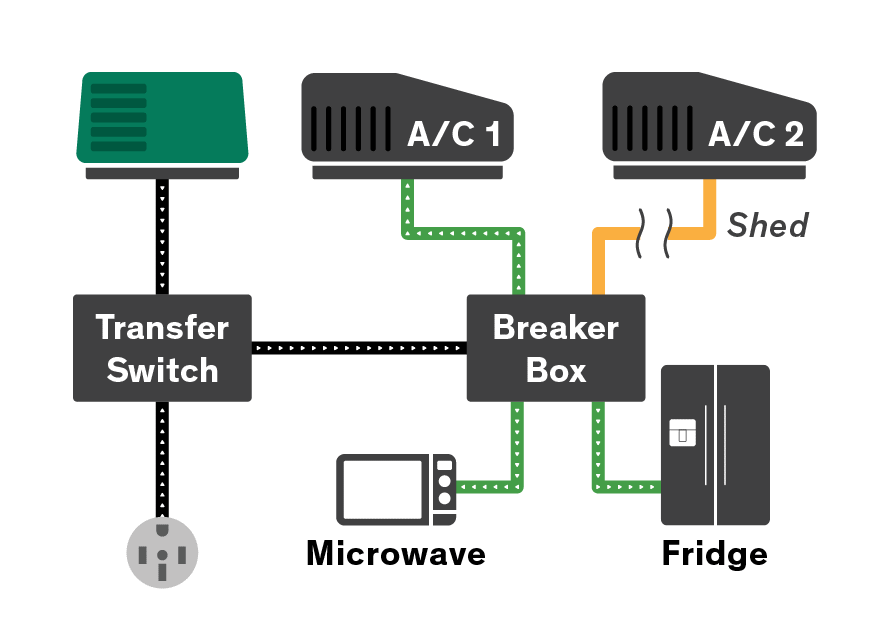
- AT A CAMPGROUND ON 30-AMP SHORE POWER - You start the microwave while the AC is running. An energy-managed system automatically reduces the AC load during the microwave cycle, then restores it. No breaker trip, no manual intervention.
- DRY CAMPING OVERNIGHT - Battery reserves are finite. A well-managed system balances loads across the night, covering lighting, the water pump, and phone charging, rather than running everything at full draw until the batteries deplete.
- RUNNING A GENERATOR ON THE ROAD - Generator capacity is limited and fuel-dependent. Energy management prevents demand spikes that could overload the generator or cause voltage instability in sensitive systems.
In each case, the system is making decisions you'd otherwise have to make yourself.

How Firefly-equipped RVs handle this
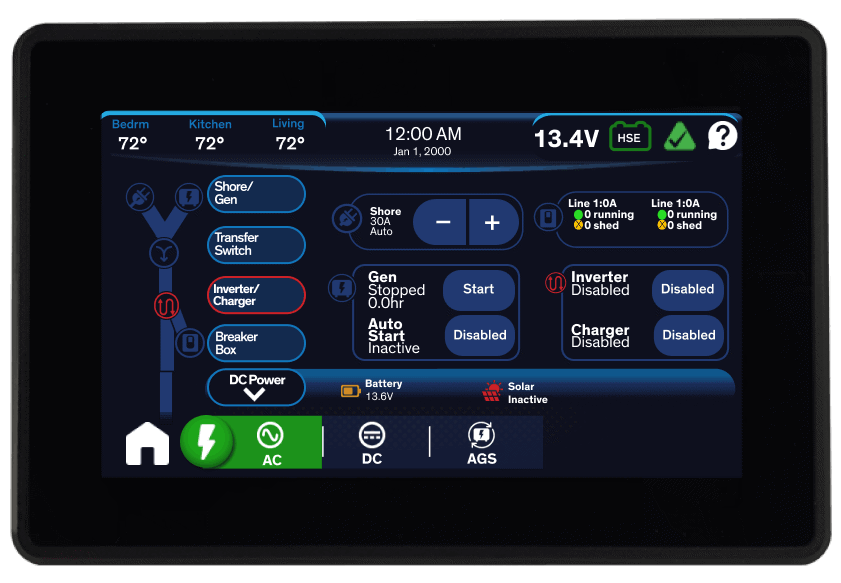
Firefly systems integrate monitoring and control in a single interface. The goal is straightforward: give you a clear picture of your RV's power state and handle load distribution without requiring your attention every time you run the coffeemaker.
Energy Management-equipped RVs display real-time system status in one organized view rather than across multiple apps or panels, actively manage load priorities so high-demand appliances don't pull the system into a fault condition, and make source transitions predictable rather than disruptive. This matters most for owners doing extended travel, dry camping, or relying on solar to reduce hookup costs. The system is designed to stay out of your way unless something needs attention, in which case it tells you clearly.
What to ask when evaluating any energy management system:
- Does it actively manage load, or does it only show you data?
- Can you see all power sources and battery state in one place?
- What happens when you exceed available capacity?
- Does it trip a breaker, or does it reduce load intelligently?
- How does the system behave during source transitions?
The answers tell you whether you're buying a meter or a manager.